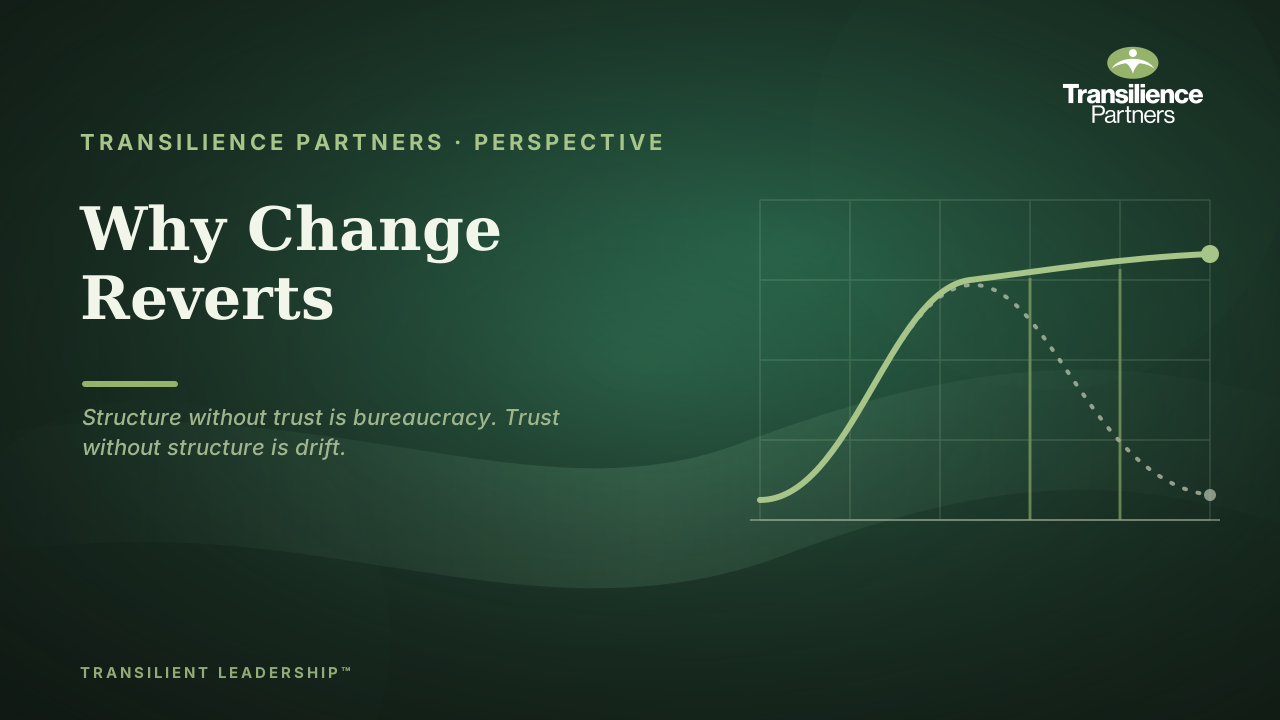
Why Change Reverts
Oct 06, 2026TRANSILIENCE PARTNERS · PERSPECTIVE
Why Change Reverts
by Doug Girvin, Transilience Partners
Structure without trust is bureaucracy. Trust without structure is drift. The case for designing for both.
A senior leadership team we worked with recently discovered something uncomfortable about itself: less than five percent of its weekly meeting time was spent actually making decisions. The rest was status — round-the-table updates, most of which could have been read in advance. The committee was busy, conscientious, and almost entirely unable to decide. So we helped them redesign the system: distinct forums for distinct kinds of work, a written pre-read, a decision log, and clear accountabilities. On paper, the fix was straightforward.
The design was never the hard part. The hard part is the question every leader who has lived through a transformation already knows: why do so many well-designed changes quietly revert? Why does the new operating model, the restructure, the better meeting cadence so often fade — until, a year later, the organization is working exactly as it did before, only now with a binder on a shelf to remind everyone that it tried?
Our answer, drawn from years of guiding organizations through exactly this, is that most change efforts solve half the problem and assume the other half will take care of itself. There are two halves. Almost every firm picks one.
The structure half
The first half is structural, and the clearest voice on it is Elliott Jaques, whose Requisite Organization argued that most organizational dysfunction is not personal but structural — and that many of the personality problems we agonize over simply fall away once the underlying structure is set right. Jaques’s signature idea is the time span of discretion: the real complexity of a role is measured by how long a person works on their own judgment before the results can be reviewed. Different levels of work — coordinating today’s execution, improving an existing system, designing a wholly new one — are as different in kind as water is from steam.
Seen this way, the five-percent problem isn’t a discipline failure. It’s a structural one. Short-horizon status, system-level review, and long-horizon strategic design were all crammed into a single weekly room — and the shortest-horizon work, being the most urgent, crowded out the longest. No amount of willpower fixes that; only separating the levels of work into forums with distinct time spans, decision rights, and accountabilities does. Structure, Jaques insists, is the precondition for people knowing what they are accountable for and having the authority to deliver it.
The relationship half
The second half is relational, and here the clearest voice is Edgar Schein. In Humble Leadership, Schein and his co-author argue that the transactional, role-and-rule-based way most organizations relate — he calls it Level 1 — is too brittle for complex, fast-moving work. What complex work needs is Level 2: relationships personal enough that people see each other as whole, speak the truth, and genuinely commit. The move from Level 1 to Level 2 he calls personization — and he is emphatic that it has nothing to do with being nice. It is what makes honest, adaptive work possible.
This is also where psychological safety comes from — a term Schein, with Warren Bennis, was using as early as 1965, long before it became fashionable. And it is decisive for change. A committee will only admit that ninety-five percent of its time is wasted if it feels safe enough to say so out loud. Rebuilding how senior people spend their time threatens status and exposes dysfunction; without trust, the conversation never gets honest, and a change built on a dishonest diagnosis cannot hold.
Why each half fails alone
Here is the trap. Org-design firms deliver the structure and leave the relationships to chance — and produce elegant accountability charts that no one trusts enough to use. Culture firms deepen the relationships and leave the structure alone — and produce warmth and candour with nowhere to land, no clear owner, no decision rights. Both are half-right, and half-right reverts.
|
Structure without trust is bureaucracy. Trust without structure is drift. |
Taken naively, the two camps even seem to contradict each other — Jaques prescribing crisp hierarchy, Schein de-emphasizing it. But they operate on different layers. Jaques designs the skeleton: who is accountable for what, over what time span, with what authority. Schein animates the nervous system: how people actually relate, trust, and tell the truth inside that skeleton. Jaques himself distinguished a requisite hierarchy that enables, from the bad hierarchies people rightly resent, and Schein’s critique lands on the bad kind. Read properly, they are the what and the how of the same organization.
The move most firms miss: synthesis
Holding two true-but-opposing ideas at once, and building something better from both, is a discipline in itself. Roger Martin calls it integrative thinking: rather than choosing structure or trust, you treat the tension as raw material for a superior answer. His strategic question — not “what is true?” but “what would have to be true?” — turns a sprawl of competing stakeholder views into a small set of choices the organization can test and own. Models, in Martin’s view, are not truths to defend but choices to be improved.
This reframes what a transformation partner is actually for. The scarce resource in most organizations is not ideas or frameworks — frameworks are downloadable. It is synthesis: the capacity to absorb an organization’s full complexity and return it as a small number of structurally sound, trusted, owned choices. That is the work that cannot be reduced to a template — and, not coincidentally, the work a client cannot easily do for themselves while also running the business.
The thesis: structure, operated through trust, owned by the client
Put the three together, and a clear point of view emerges, one we’ve watched hold up across engagements:
|
Durable transformation is requisite structure, operated through trusted relationships, synthesized into choices the client owns. Change reverts not because the design was wrong, but because adoption was never owned — and adoption is owned only when the structure correctly matches accountability, authority, and time-span to the real levels of work; the people inside it trust each other enough to speak truth and commit; and the plan is something the client created and localized, not an algorithm imported from outside. |
The causal chain is the whole argument: structure enables clear accountability, trust enables honest commitment, synthesis produces an owned choice, and ownership is what makes adoption stick. Skip any link, and the change decays back to the mean.
What it looks like in practice
Return to the leadership team and the five-percent problem. The structural move was to split the catch-all meeting into forums matched to levels of work: a weekly tactical forum for execution, driven by a short written pre-read so the room could decide rather than narrate; a monthly strategic forum for reconciliation; and dedicated setup sessions for major growth files, where leaders establish context and outcomes before work enters the regular cadence.
But the structure only took because the team trusted the process enough to name the problem honestly in the first place — and because they didn’t receive the design as a finished product. They received building blocks and localized them to their own indicators, context, and language. And it was paced deliberately, over roughly a year, because installing a new operating system is itself high-stakes work that can’t be bolted on overnight without breaking the operation it’s meant to improve.
|
They picked up very quickly on the nuances of our work and our context. We couldn’t have found the time or the ability to synthesize all of this ourselves. — Vice-President, regional agency |
Why it matters
The evidence on adoption is blunt. Prosci’s benchmarking finds that 93% of initiatives with excellent change management meet or exceed their objectives, versus just 15% with poor change management — and that projects with highly effective sponsors are 79% likely to succeed, compared with 27% with ineffective sponsors. Bain’s decade-long study of more than a thousand companies found decision effectiveness correlated with financial performance at a 95% confidence level, with the strongest decision-makers returning more than four times as much to shareholders over five years as their peers.
Structure explains why those decisions can be made; trust explains why they’re made honestly; synthesis and ownership explain why the new way survives contact with the everyday. The firms that treat change as a design problem keep producing beautiful designs that revert. The discipline that lasts is the harder one: refusing the either/or, and building for structure and trust at once — then handing the result to the people who have to live inside it.
Notes & sources
- Jaques, Elliott — Requisite Organization (2nd ed., 1996): time-span of discretion; levels/strata of work; accountability–authority match.
- Schein, Edgar & Peter — Humble Leadership (2018): Level 1→2 relationships, personization, Humble Inquiry.
- Martin, Roger — A New Way to Think (2022): integrative thinking; “what would have to be true?”
- Prosci benchmarking: 93% (excellent CM) vs 15% (poor) meet/exceed objectives; sponsors 79% vs 27%. (prosci.com.)
- Bain, Decide & Deliver / decision-effectiveness research: ~95% confidence correlation with financial results; top decision-makers return >4× to shareholders over five years. (bain.com.)
The Transilient Times
Field notes on leading through change: one email a month, with a summary of every new post.
One email a month. We will never sell your information, for any reason.