Leadership Development Has a Blame Problem
Nov 09, 2026TRANSILIENCE PARTNERS · PERSPECTIVE
Leadership Development Has a Blame Problem
by Doug Girvin, Transilience Partners
Richard David Hames says the industry is part of the problem. He's half right.
Also published as the first edition of Leading Is a Verb, my LinkedIn newsletter: one idea every other Monday about why organizations stall, and what effective ones do differently.
I read an essay last week that I couldn't put down, partly because I agreed with most of it, and partly because it was aimed squarely at people like me.
It's called "Bullshit We Call Leadership", by the futurist Richard David Hames. His argument, boiled down: the leadership industry has spent fifty years selling an idea vague enough to be taught forever and never held to account. Worse, every time something breaks, we call it a "failure of leadership". That lets us blame a person and never look at the system that produced the result.
I've spent most of my working life in leadership: building and running my own companies, and working alongside leaders from the Fortune 10 down to regional organizations in 14 countries, often on mission-critical systems where failure wasn't an option. That's a lot of leaders, and a lot of cultures. Now I work in the very industry he's taking apart. So I wanted to dismiss it. I couldn't. Here's where I think he's right, where I think he's wrong, and what we do about it.
Where he's right
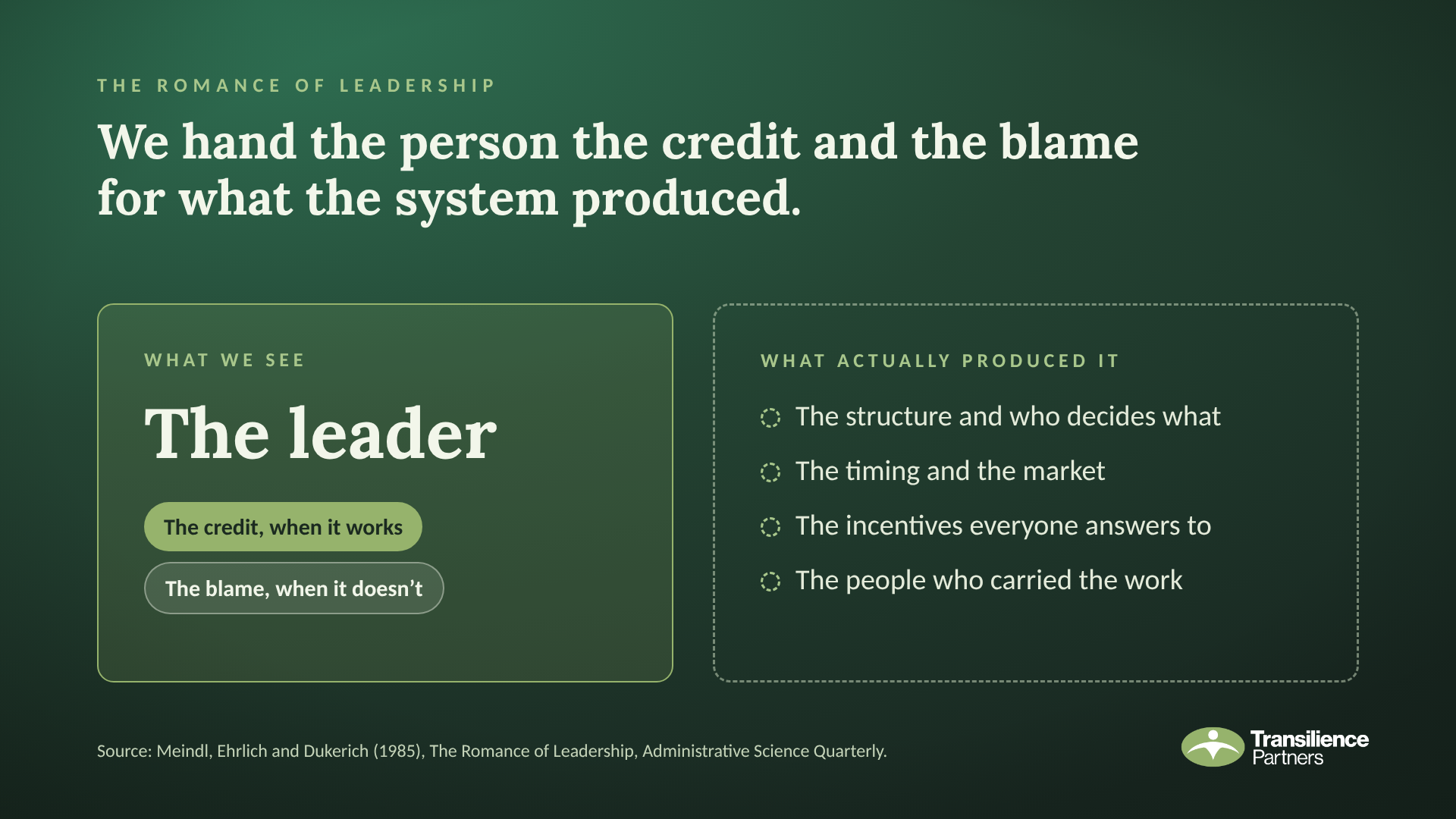
We blame people for what systems produce, and we credit them for it too. This isn't just a provocation. James Meindl's research in the 1980s called it "the romance of leadership": we credit and blame leaders for outcomes driven largely by circumstances and structure. "A failure of leadership" is a comfortable diagnosis. It means nobody has to redesign anything. The same habit runs the other way: the celebrity founder gets the magazine cover, while the system, the timing and the thousands of people who actually built the thing get a footnote. Founders matter. They're part of the success, not the whole of it. I say that as a founder myself, and after ten years of working with founders around the world. The qualities we credit them with are usually real. They're just not enough. The rest of the success lives in the system around them, and in the people who carry it.
Training goes back into an unchanged system. Michael Beer at Harvard calls it the great training robbery. Companies send managers on a program; they come back energized, and they walk into the same reporting lines, the same incentives, the same meetings that decide nothing. Within a month, the old system wins. That isn't the training failing. It's the system doing exactly what it was built to do.
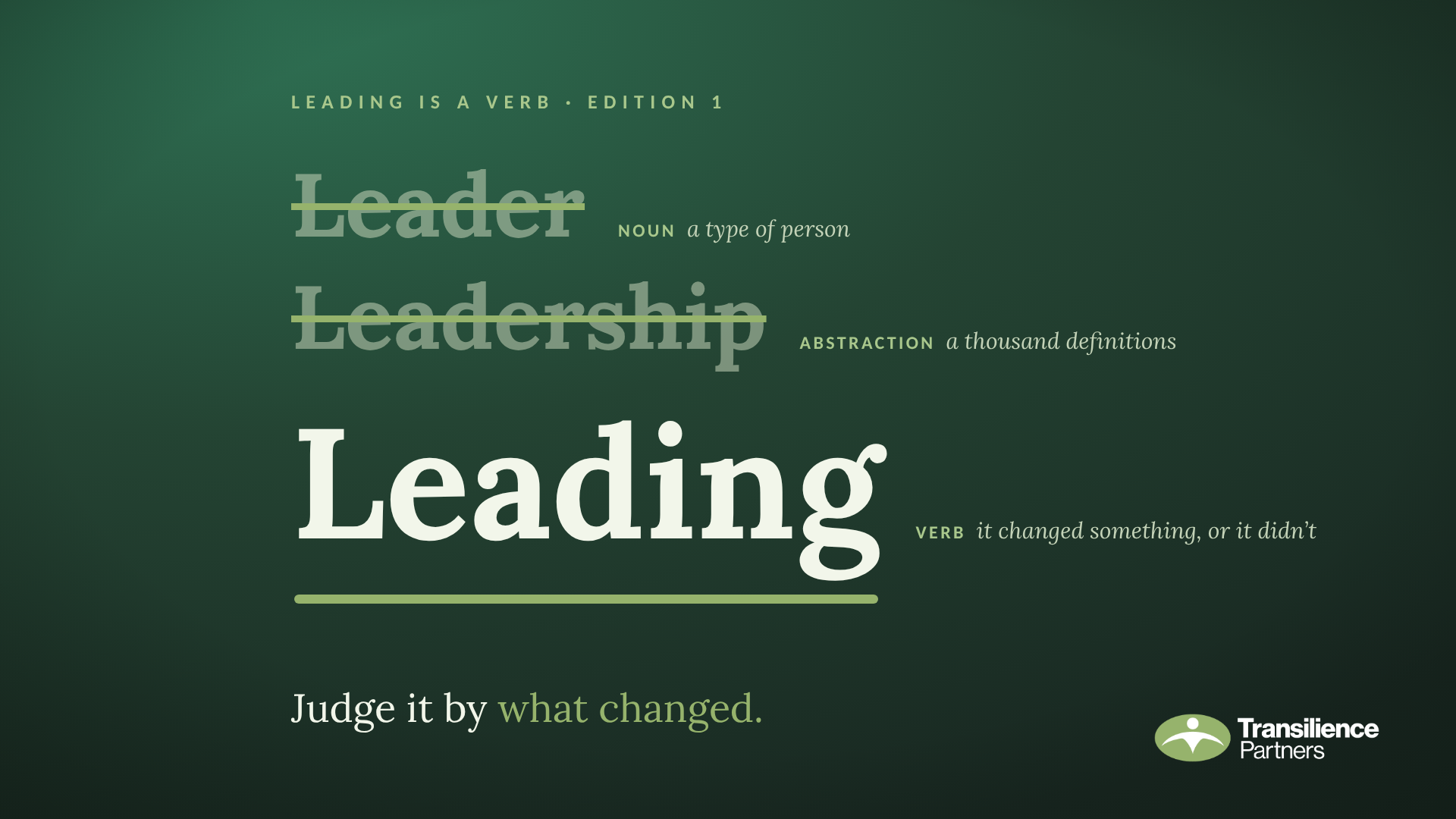
Leading is a verb. Hames makes a point I'll be stealing for years. Leading is an activity: something changed because of what you did, or it didn't. Leader is a noun, a type of person. Leadership is an abstraction nobody can define. Each step up that ladder makes the idea easier to sell and harder to test. We now call the top three layers of an org chart "the leadership" whether or not anyone in them is leading anything.
What it looks like from where I've sat
In thirty years of building and running companies, and working with organizations of every kind, public and private, for-profit and not-for-profit, I've watched plenty of good decisions die in the gap between the boardroom and Monday morning.
Every change has two parts. There's the part you can decide: the new structure, the new system, the strategy. It gets a budget, an owner and a date. Then there's the part someone has to carry: the people who have to make it work. That part gets none of those things.
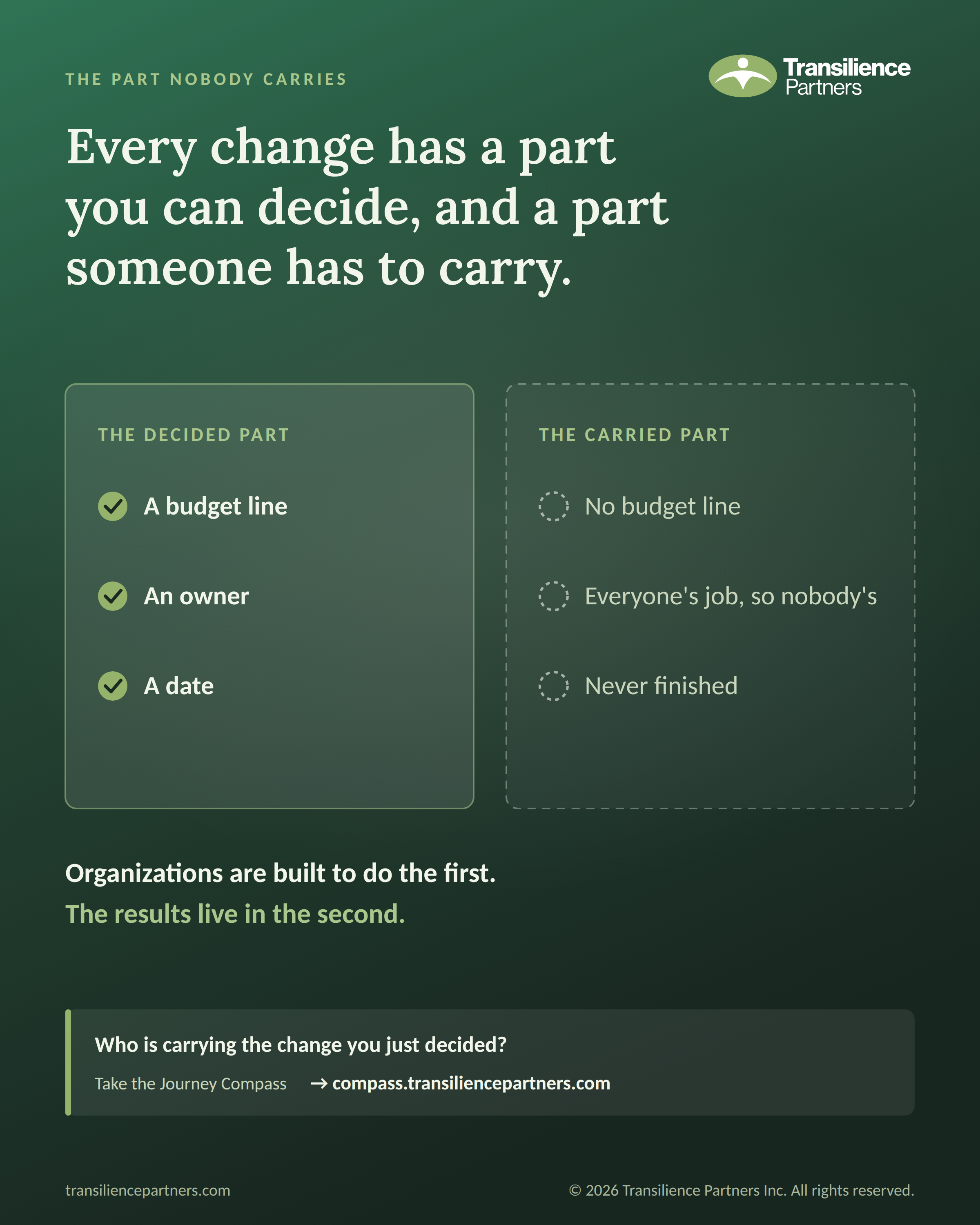
When a change fails, we call it a leadership failure. In my experience, it's far more often an ownership failure. Nobody was ever handed the carried part.
Where he's wrong
Hames concludes that the industry can't be fixed, because it's built to sell abstraction. On that point, the evidence doesn't back him.
A 2017 meta-analysis of 335 studies, published in the Journal of Applied Psychology, found that leadership development measurably improves on-the-job behaviour and organizational results when it's designed properly. The design is the whole story:
- start from what actually needs to change;
- practise in real work, rather than listen to lectures;
- spread sessions over time, rather than cramming them into an event;
- deliver it in context, close to the work.
The three-day offsite he rightly mocks is the version the research says doesn't work. That isn't an argument against developing people. It's an argument against doing it badly.
And his alternative, leadership as a collective effort to improve the human condition, is noble but no easier to use on a Monday morning than the abstraction he's attacking.
Making leading testable
If leading is a verb, judge it by what changed. Here's what that means in practice:
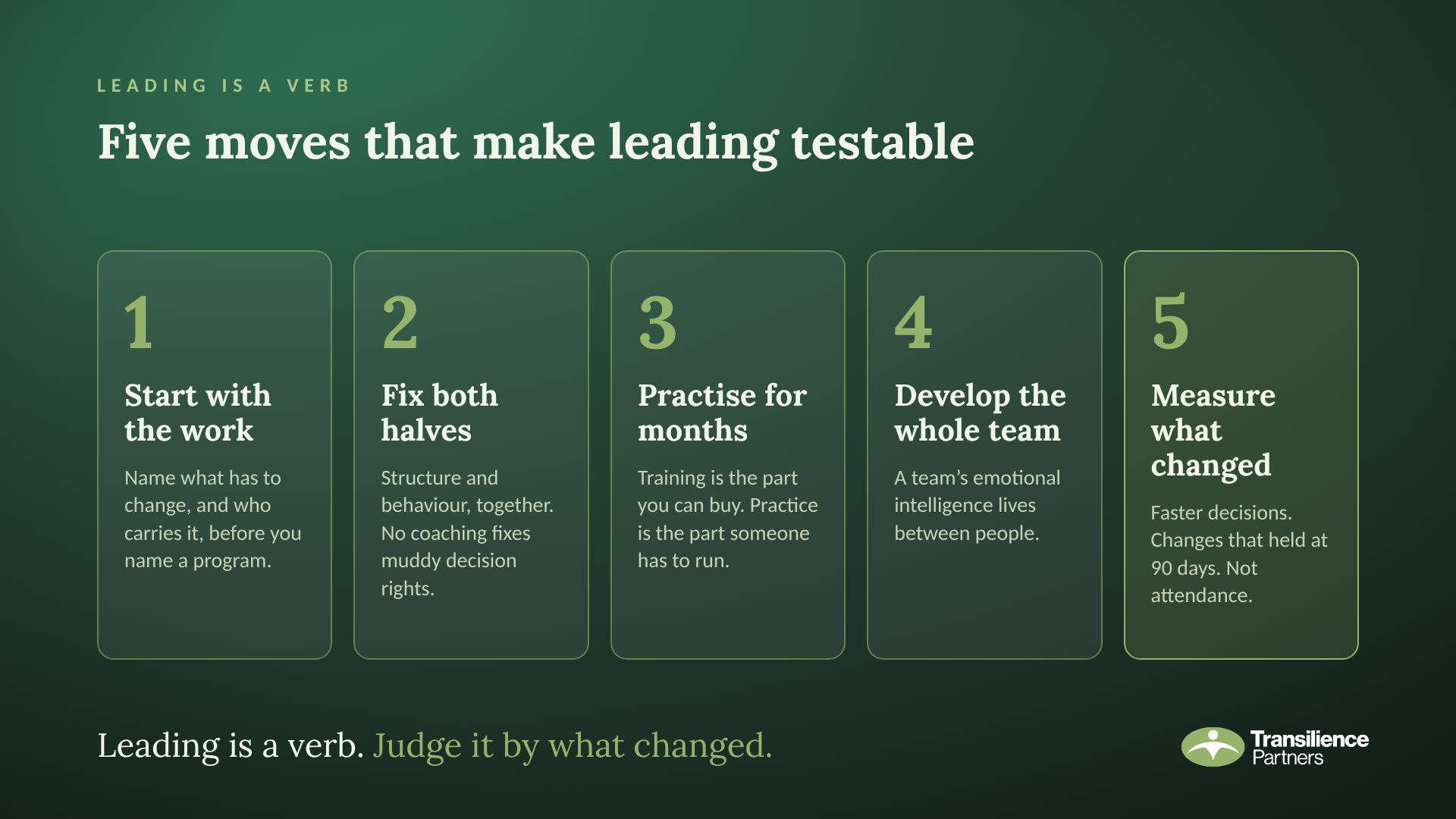
- Start with the work, not the person. What has to change, and who has to carry it? Name the carried part before you name a program.
- Fix structure and behaviour together. If decision rights are muddy, no amount of coaching will make meetings decide. If people revert under pressure, no org chart will hold. One conversation, both halves.
- Practise for months, not days. Training is the part you can buy. Practice is the part someone has to run.
- Develop the team, not just the person at the top. A team's emotional intelligence isn't the leader's multiplied by eight. It lives between people.
- Measure consequence, not attendance. Did decisions get faster? Did the change hold at 90 days? Did the team handle the hard moment without escalating it? Those are the questions that matter.
I'll be honest: Hames would poke holes in our own work too. Our career map is organized by job level, and that's precisely the "leadership as position" trap he describes. We're rethinking how we describe it: by what changes in the work at each stage, not by rank.
That's the point of reading people who disagree with you.
Leading is a verb. Judge it by what changed.
Is your organization built to decide, or to carry things through?
Most are built for the first and wonder why the second never happens. Our free diagnostic, Optimized or Effective?, asks how decisions and change actually move through your organization, then shows you which half your structure is built for and where to start. Take the free diagnostic →
— Doug
Doug Girvin is Co-Founder at Transilience Partners. He has spent more than 30 years in leadership: founding and running technology companies, and working alongside leaders from Fortune 10 enterprises to regional organizations in 14 countries on mission-critical, enterprise-scale problems.
Notes & sources
- Hames, R. D. (25 May 2026). "Bullshit We Call Leadership". The Hames Report, Substack.
- Meindl, J. R., Ehrlich, S. B. and Dukerich, J. M. (1985). The Romance of Leadership. Administrative Science Quarterly.
- Beer, M., Finnström, M. and Schrader, D. (2016). Why Leadership Training Fails, and What to Do About It. Harvard Business Review. Summary: Who's to blame for the great training robbery?
- Lacerenza, C. N. et al. (2017). Leadership training design, delivery, and implementation: a meta-analysis. Journal of Applied Psychology.
The Transilient Times
Field notes on leading through change: one email a month, with a summary of every new post.
One email a month. We will never sell your information, for any reason.