
Effective × Resilient
Sep 15, 2026THE EFFECTIVENESS DOCTRINE · NO. 7
Resilience isn't bouncing back to where you were. It's staying effective at a target that moved while you weren't looking.
By Doug Girvin · Transilience Partners
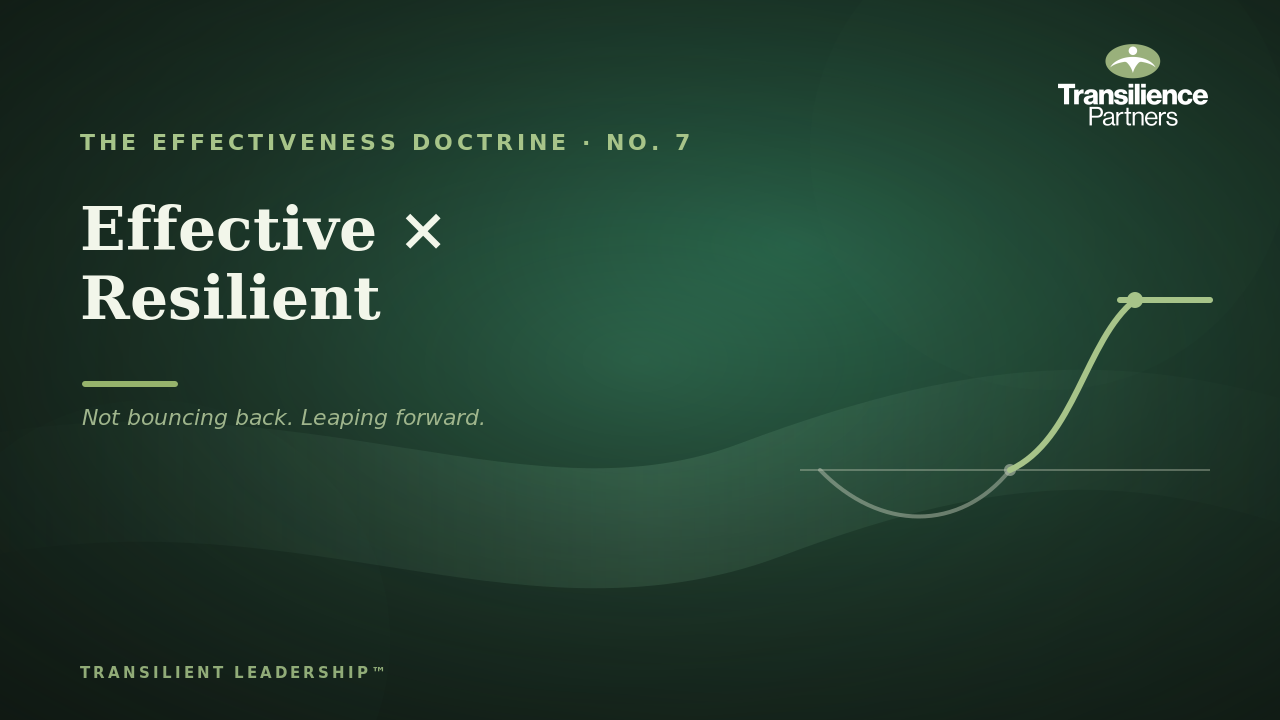
We deliberately named this firm Transilience, and the word carries the whole argument. Resilience means bouncing back — absorbing a shock and returning to where you were. Transilience means leaping across — transforming in response to a shock, arriving somewhere new rather than merely surviving back to the old position. The distinction matters more every year, because in a world that doesn't hold still, bouncing back to where you were is often just an efficient return to the wrong place.
This essay connects the two ideas that run through everything we do: effectiveness and resilience. They look like different concerns — one about doing the right things, one about withstanding adversity. They are, I'll argue, the same capacity seen from two angles. And efficiency, pursued as a master, quietly destroys both.
THE EFFICIENCY–RESILIENCE TRADEOFF
Earlier in this series I made the case that relentless efficiency strips the slack an organization needs to adapt. That same dynamic is, in the language of systems, the efficiency–resilience tradeoff — and it is one of the most robust findings in how complex systems behave. A system optimized for maximum efficiency is, almost by definition, fragile. Every redundancy has been removed, every buffer minimized, every resource committed to its single most productive use. It performs beautifully—right up until conditions change, when it has no reserves, no alternatives, and no room to respond.
Nature understood this long before management did. A monoculture is the most efficient possible use of a field — one optimized crop, maximum yield. It is also the most fragile: one pest, one blight, and the whole field is gone. Diverse ecosystems are less efficient in any single dimension and far more resilient, because their redundancy—their apparent waste—is exactly what lets them absorb a shock and keep functioning. The "inefficiency" is the resilience. They are the same thing.
The redundancy that looks like waste on an efficiency metric is the same redundancy that looks like survival when the world changes. You cannot strip one without losing the other. Watching our supply chains wobble under the effects of COVID demonstrated the challenge of efficiency as the core mantra.
WHY EFFECTIVENESS AND RESILIENCE ARE THE SAME PROJECT
Here is the connection that gives the firm its name. Effectiveness, as this series has defined it, is the capacity to do the right things and to keep doing the right things as the definition of "right" changes. Resilience — real resilience, the transilient kind — is the capacity to absorb change in the world and transform in response rather than break. Look closely, and these are not two capacities. They are one capacity described in two vocabularies.
An organization that can re-aim — that notices the goal has moved and realigns toward the new one is, in the same motion, both effective and resilient. Effective, because it keeps pursuing the right end. Resilient, because the very thing that would have broken a rigid organization (a change in the environment) is something it absorbs and adapts to. The capacity to re-aim is the shared root. Effectiveness is what you call it when you're looking at the goal. Resilience is what you call it when you're looking at the shock. The thing itself is the same.
That's why efficiency, as a master, is so corrosive: it attacks the shared root. By stripping slack, eliminating redundancy, and optimizing every resource toward the current goal, it removes precisely the capacity that makes an organization both effective and resilient. It trades the ability to re-aim for a marginally better performance at the present aim — a terrible trade the moment the aim needs to change.
PERSONAL AND SYSTEMIC, THE SAME SHAPE
What's striking is that this pattern holds at every level. It is true of a person and true of an enterprise, in the same shape. A leader who has optimized every hour, eliminated all slack, and fully committed to executing the current plan is efficient, and brittle. The moment something unexpected lands, they have no reserve of attention, no flexibility, no capacity to absorb it and adapt. Burnout, at the individual level, is the efficiency–resilience tradeoff playing out in a human being: a person optimized past the point where they can absorb a shock.
The resilient leader, like the resilient organization, deliberately holds reserve — uncommitted time, the capacity to reflect, the slack to respond to what wasn't planned. It looks less efficient. It is the source of their effectiveness, because it lets them re-aim when the situation demands it, rather than execute a plan reality has already overtaken. The same logic that builds an adaptive organization builds an adaptive leader. This is why our work moves between the systemic and the personal so naturally — they are not two domains. They are the same principle at two scales.
Burnout is what the efficiency–resilience tradeoff looks like inside a person. The reserve that makes a leader look less optimized is exactly what lets them adapt.
THE LEADERSHIP POSTURE THIS REQUIRES
If effectiveness and resilience are the same project, and if efficiency-as-master attacks them both, then the leadership task is to hold a particular and somewhat counter-cultural posture: to protect the apparent inefficiencies — the slack, the redundancy, the reserve, the unmeasured capacity — against the constant pressure to optimize them away. That pressure is relentless, because each individual cut looks rational and the cumulative cost (lost adaptability) is invisible until the moment you need the thing you cut.
This is not an argument for waste, and it is not an argument against efficiency. It is an argument for sequence and judgment: for being effective first, resilient by design, and efficient in service of both rather than at their expense. The leader who understands this stops asking only "how do we do this with less?" and starts asking "what must we protect so that we can still adapt?" That second question is the transilient question. It is the difference between an organization that bounces back to a world that no longer exists and one that leaps across to the world as it now is.
Next, the series closes: what a leader who has stopped worshipping efficiency actually does — a practical agenda for leading after efficiency.
WHERE IS YOUR ORGANIZATION — OPTIMIZED, OR EFFECTIVE?
Take the five-minute diagnostic and see which of the five dimensions of effectiveness is holding the others back: Are you Optimized or Effective?
Stay in the Loop!
Subscribe to get notifications of new posts
We hate SPAM. We will never sell your information, for any reason.