
Culture Is Not the Soft Stuff
Sep 15, 2026THE EFFECTIVENESS DOCTRINE · NO. 3
"Culture eats strategy" is half a truth. The full truth: culture is the only system that lets strategy change its mind in time.
By Ashley Chase, with Doug Girvin · Transilience Partners
Of all the phrases that have entered the management vocabulary, "culture eats strategy for breakfast" may be the most quoted and the least understood. It gets deployed to mean something vaguely reassuring — that people matter, that values count, that you cannot win on spreadsheets alone. All true, and all beside the point. The phrase is half a truth, and the missing half matters.
Here is the full version. Culture does not eat strategy. Culture is the system that keeps strategy alive— the one that lets an organization notice when its strategy has stopped working and change it before the failure becomes terminal. Culture is not the soft counterweight to hard strategy. It is the mechanism of adaptation, and adaptation is the hardest, most valuable thing an organization can do.
THE BINARY THAT GETS IT WRONG
We have inherited a lazy division of the world. Strategy, structure, finance, operations — the "hard" stuff, the things you can model and measure. Culture, leadership, engagement, trust — the "soft" stuff, the things you gesture at when the hard stuff is handled. The implication is that soft means optional, or at least secondary: nice if you can get to it, but not where the real work is.
This has it exactly backwards. The soft stuff is the hard stuff — hard in the sense of difficult, and hard in the sense of load-bearing. Anyone can write a strategy. The difficulty has never been formulating the right plan; it has been building an organization that can execute a plan, notice when the plan is wrong, and re-aim without falling apart. That is a cultural capacity, not a strategic one. And it is brutally hard to build, which is precisely why it gets filed under "soft" and avoided.
Culture is not the soft stuff. It is the unseen architecture of performance - the operating system every strategy runs on, and the only thing that lets the strategy update itself.
WHAT CULTURE IS ACTUALLY FOR
Strip away the connotations and ask the functional question: what does culture do? In an effectiveness frame, the answer is specific. Culture is the organization's capacity to re-aim — to perceive that the target has moved and to realign toward the new one quickly, coherently, and without needing a consultant to authorize every step.
That capacity is built from things that sound soft and are anything but. It requires trust, because people who do not trust their leaders will not surface the inconvenient signal that the strategy is failing. It requires low fear, because frightened people optimize for not being blamed, not for being right. It requires genuine initiative, because re-aiming depends on people closest to the change acting on what they see rather than waiting for permission. And it requires fast, honest learning — the willingness to say "this is not working" early, when it is still cheap to change course.
Take those away and you have an organization that cannot re-aim no matter how good its strategy is. The signals that the goal has moved arrive — they always arrive — but they die in transit, because no one feels safe carrying bad news upward, or empowered to act on it, or confident it will be heard. The strategy executes flawlessly into a target that is no longer there.
WHY EFFICIENCY-FIRST CULTURES CANNOT RE-AIM
This essay is directly connected to the previous essays in this series. An organization optimized to the bone for efficiency has, almost by definition, destroyed its capacity to re-aim—because re-aiming runs on exactly the slack efficiency eliminates.
Noticing that the goal has moved takes attention that is not already fully committed. Acting on it takes capacity that is not already spoken for. Surfacing the uncomfortable truth takes a culture where doing so is safe — and high-pressure efficiency cultures are rarely safe, because when every hour is utilized, and every target is stretched, the rational individual move is to keep your head down and hit your number, not to raise your hand and say the number is measuring the wrong thing. Efficiency, pursued as a master rather than a servant, systematically removes the conditions that adaptation requires. It optimizes the organization into a state where it can only do what it is already doing.
An efficiency-first culture can execute. What it cannot do is notice, in time, that it is executing the wrong thing - and that is the only failure that is fatal.
WHAT RE-AIMING LOOKS LIKE UP CLOSE
In the work I do with leadership teams, the capacity to re-aim is rarely missing because people are incapable of it. It is missing because the conditions have not been built. A team that cannot give each other honest feedback cannot re-aim, because re-aiming begins with someone saying out loud that the current direction is wrong — and that sentence requires a level of safety most teams have never deliberately constructed.
When a team learns to do this — to surface disagreement early, to treat a change of direction as intelligence rather than failure, to separate "this is not working" from "someone is to blame" — something shifts that no strategy document can produce. The organization gains the ability to update itself. The strategy becomes a living position rather than a fixed bet. And the leadership team stops being the bottleneck through which every course correction must squeeze, and instead becomes the people who built an organization that can correct course on its own.
That is cultural work, and it is the hardest work there is. It is also, not coincidentally, the work that most directly determines whether a strategy survives contact with a changing world.
CULTURE MULTIPLIED BY STRATEGY
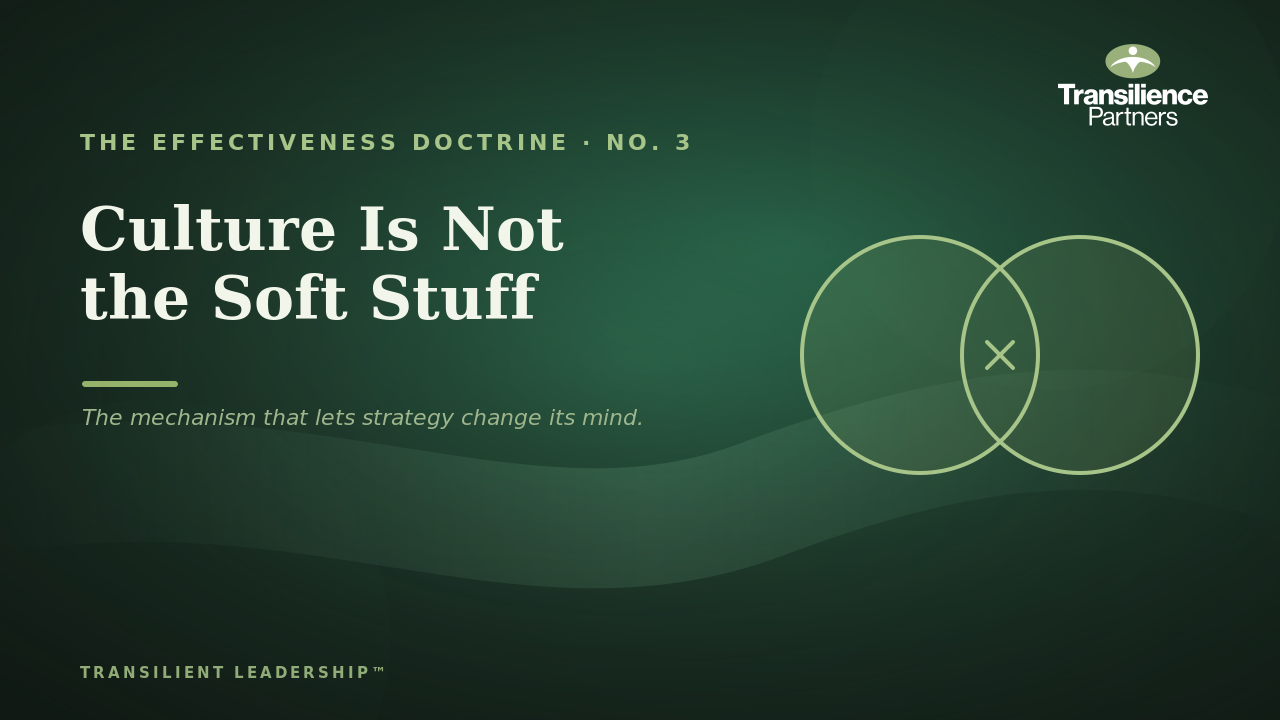
So we should retire the idea that culture eats strategy, because it sets the two against each other as if you had to choose. You do not. The highest performance does not come from culture over strategy, or strategy over culture. It comes from culture multiplied by strategy—and the reason it's multiplication, not addition, is that each can zero out the other. A strategy multiplied by a culture that cannot execute or adapt is worth very little. A strong culture multiplied by no clear strategy is energy without direction. Together, aligned, they produce what this whole series is about: effectiveness—doing the right things, and retaining the capacity to keep doing the right things as the definition of "right" keeps changing.
Culture is not soft. It is the architecture that determines whether everything else you have built can adapt or merely persist. Treating it as the optional, human-interest layer on top of the real work is the most expensive mistake in management — because it leaves the one capacity that determines survival to chance.
Next in the series: the measurement trap — how the metrics meant to serve the goal quietly become the goal, and what it takes to measure effectiveness rather than just efficiency.
WHERE IS YOUR ORGANIZATION? — OPTIMIZED, OR EFFECTIVE?
Take the five-minute diagnostic and see which of the five dimensions of effectiveness is holding the others back: Optimized or Effective?
Stay in the Loop!
Subscribe to get notifications of new posts
We hate SPAM. We will never sell your information, for any reason.