
The Law of Diminishing Returns
Sep 15, 2026THE EFFECTIVENESS DOCTRINE · NO. 2
The first efficiency program pays for itself. The third one quietly costs you the capacity to adapt.
By Doug Girvin · Transilience Partners
Every efficiency program looks like a success at the start, because the first one usually is. There is always obvious waste in a system that has never been optimized — duplicated effort, idle capacity, processes that grew by accretion and never got pruned. Cut them, and the savings are immediate and real. The program pays for itself, the leadership team is validated, and the logic becomes self-evident: if it worked once, do it again.
So they do it again. And this is where the trouble starts — not with a dramatic failure, but with a curve that almost nobody is watching.
THE SHAPE OF THE CURVE
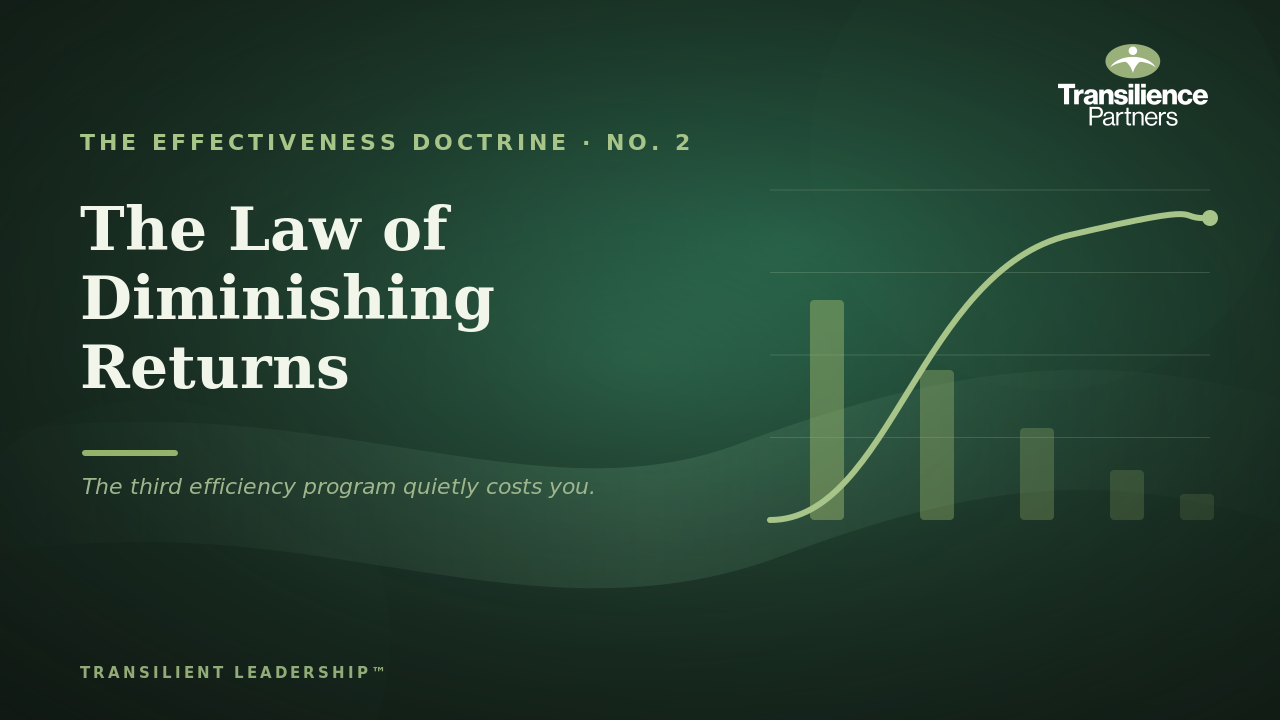
Efficiency gains follow an S-curve, and the back half of that curve is unkind. The first round of optimization harvests the obvious waste — high return, low cost. The second round goes after the less obvious. By the third or fourth, you are spending real organizational energy to extract gains that are a fraction of what the first round delivered. The line is still moving up, which is why people keep pulling the lever. But the cost of each additional point of efficiency is climbing fast, and the returns are flattening toward zero.
If diminishing returns were the whole story, the worst outcome would be wasted effort — spending a dollar to save a dime. That would be bad enough. But it is not the whole story, because efficiency does not just stop helping. Past a certain point, it starts doing damage.
Efficiency doesn't plateau gracefully. Past the inflection point, the same discipline that created value starts quietly removing it.
WHAT GETS CUT WHEN THERE IS NOTHING LEFT TO CUT
When the obvious waste is gone and the pressure to keep optimizing remains, organizations start cutting things that were never waste. They cut slack—the unallocated time, the redundant capacity, the margin in the system—and call it waste because, on an efficiency metric, that is exactly what it looks like. By the logic of efficiency, a person who is not fully utilized is an inefficiency to be eliminated.
But slack is not waste. Slack is the capacity to absorb a shock, take on the unexpected, notice when something has changed, and respond before it becomes a crisis. Slack is where adaptation happens. An organization optimized to the bone has no room to manoeuvre — every person, every process, every dollar is committed to running the current plan as efficiently as possible. It is magnificently productive and utterly unable to turn.
This is the brittleness trap. We tend to think of efficiency and resilience as both being "good," and assume you can have both. You cannot, past a point. They trade against each other. The more completely you optimize a system for its current task, the less capacity it retains to do anything else — including survive a change to the task itself.
THE QUARTER THAT FELT LIKE A WIN
I have watched a version of this story play out more than once, and it usually looks like a success right up until it doesn't. A company under pressure runs a hard efficiency program. Costs come down, utilization goes up, and the quarter looks excellent — the best in years on every operational metric. The efficiency logic is vindicated in the numbers.
What the numbers don't show is what it cost to produce them. The experienced people with institutional knowledge were optimized out because their roles looked redundant on paper. The developmental projects with no immediate return were cancelled because they could not be justified on an efficiency basis. The slack in the senior team that used to get spent scanning the horizon, now fully consumed by running the optimized machine. The organization got leaner and the quarter got better, and the capacity to notice and respond to what came next got quietly hollowed out.
Then the environment shifted — as it always does — and the same organization that had just posted its best operational quarter discovered it had no one left who could see the shift coming, and no room to respond to it once it arrived. The efficiency was real. So was the cost. They just appeared on different statements, in different quarters.
A perfectly efficient organization is a perfectly committed one. It has optimized away the one thing it most needs when the world changes: the room to do something different.
READING THE CURVE BEFORE IT READS YOU
This is not an argument against efficiency. It is an argument for knowing where you are on the curve — and for recognizing that the discipline which created value in the first round can destroy it in the fourth. The skill is not optimizing harder. It is knowing when to stop, and what to protect from optimization entirely.
A few signs you have crossed the inflection point:
- The gains are shrinking, and the effort to get them is growing.
- "Waste" increasingly means slack, cross-training, redundancy, or developmental work — the things that turn out to be load-bearing.
- Your most experienced people are fully utilized and no one is scanning the horizon.
- The organization is excellent at its current task and visibly unable to take on anything new.
If those sound familiar, the answer is not another efficiency program. It is to start protecting the slack you have left, and to shift the question from how do we do this with less? to are we still sure this is the right thing? That shift — from optimizing the known to retaining the capacity to re-aim — is the move from efficiency to effectiveness. It is the whole game, and it is what the rest of this series is about.
Next: why culture, properly understood, is the mechanism that lets an organization change its mind in time — and why that makes it the opposite of soft.
WHERE IS YOUR ORGANIZATION? — OPTIMIZED, OR EFFECTIVE?
Take the five-minute diagnostic and see which of the five dimensions of effectiveness is holding the others back: Optimized or Effective?
Stay in the Loop!
Subscribe to get notifications of new posts
We hate SPAM. We will never sell your information, for any reason.