
From Five Teams to One
Sep 15, 2026CLIENT STORY · TRANSILIENT LEADERSHIP™
A newly designed structure was shared with the leadership team, and it landed badly. Leaders were openly concerned. Some defaulted to conflict. Under pressure, the instinct was to add more people to the problem rather than change how the work was done. By Transilience Partners. This is an anonymized client story. No names, no identifying specifics, and no attributed quotes — the figures are directional rather than audited. We tell it because the pattern is common enough that you may recognize your own organization in it.
AT A GLANCE: The Organization
A Canadian non-profit delivering donor-funded international trade-development programs. Roughly thirty people.
THE SITUATION
Rapid growth into multi-year, multi-million-dollar mandates — run on the habits of a much smaller organization. The focus. Operating model, role clarity, evidence-based performance management, and leadership development — treated as one problem rather than four. The result. Leadership behaviour shifted from conflict to collaboration within about four months. The client re-engaged to extend the work.
THE CHALLENGE
After a turnaround and a period of fast growth, the organization had won several multi-year, multi-million-dollar mandates — and roughly doubled its overhead to deliver them. But it was still operating the way it had at a fraction of the size: as a set of relationship-based, country-by-country teams, each doing things its own way. That had worked. It was, in fact, how they had won. Individual heroics and deep personal relationships are a perfectly good operating model at twelve people chasing small contracts. They are a liability at thirty people delivering signed multi-year mandates, where revenue depends on delivering against contract — at quality, on time, provably. So the symptoms arrived in the usual order. Performance reviews were not tied to outcomes. Role boundaries blurred, then got defended. A new structure was designed and shared, and the leadership team received it as a threat rather than a plan. When pressure rose, the reflex was to add headcount rather than ask whether the work itself needed to change. That last reflex is the tell. Adding people to a role-clarity problem does not solve it. It multiplies it.
THE APPROACH
We ran a phased optimization, then a continuation focused on making the new model durable. Throughout, we treated structure, role clarity and performance as one conversation — not three separate HR initiatives that happen to be running in the same year. Performance, redesigned.
A single evidence-based system: weighted SMART goals, observable competencies, a whole-team view of business-development contribution rather than a sales quota, and light compliance — rolled into one transparent composite. It was supported by a live calculator, a year-compounding tracker, and a plain-language employee guide, because a performance system nobody can explain is a performance system nobody uses. Role clarity as a practice.
A four-layer RACI, built not as a task grid but as a shared language for accountability across the whole organization. It fed job descriptions and escalation paths, and it made the move possible — from a country-centric model to expertise-aligned delivery.
Leadership that matches the model.
A workshop and a five-module program built around four shifts:
- your first team is your peers;
- listen to understand;
- collaborate because roles intersect, not because you get along;
- and performance management grows people — it is not paperwork.
Leaders left with written, public, behavioural commitments. Public matters.
A commitment nobody witnessed is a preference. The cadence to sustain it. Onboarding plans, a ninety-day probationary framework, and a one-on-one and feedback rhythm that compounds the year into the review instead of restarting it every month.
WHAT CHANGED
Within roughly four months of the new structure going live, the shift was visible — and it showed up first in behaviour, not in metrics. Leaders who had defaulted to conflict were openly encouraging one another. Directors organized around how to implement the change and support their teams, rather than around resisting it.
The senior team began operating as one leadership group rather than five competing silos. The tools moved into daily use. Three-sixties, coaching, probationary reviews, one-on-ones and the performance frameworks were adopted rather than shelved — which is the harder outcome, and the one most transformation work quietly fails to reach.
Project-manager time began shifting from logistics to delivery outcomes, as a dedicated operational layer absorbed the coordination load. One-on-ones moved from status updates to real decisions and real development.
The clearest signal that the change was holding: the organization re-engaged us to extend the work.
WHY IT WORKED
We built proof during the work, not after it. The tools were designed to be used, then refined from real use. Nothing was handed over as a finished artifact to be admired and ignored. One through-line, not three initiatives. The RACI, the goals and the leadership behaviours all reinforced the same aim: turn signed work into delivered results.
Run as separate programs, each would have competed for the same attention, and none would have survived contact with a busy quarter. It was designed for self-sufficiency.
The goal was a client who can run the model without us — leaders coached to hold the new behaviours, and an internal owner to carry it forward. Consulting that makes itself necessary is a business model, not a result.
THE HONEST CAVEAT
Four months is fast for behavioural change, and we would not promise it. What made it possible here was a leadership team that was genuinely alarmed — the new structure had already landed badly, so the problem was undeniable before we arrived. Urgency is an asset. Organizations that are merely uneasy, rather than alarmed, tend to move slower, and the work has to be designed for that.
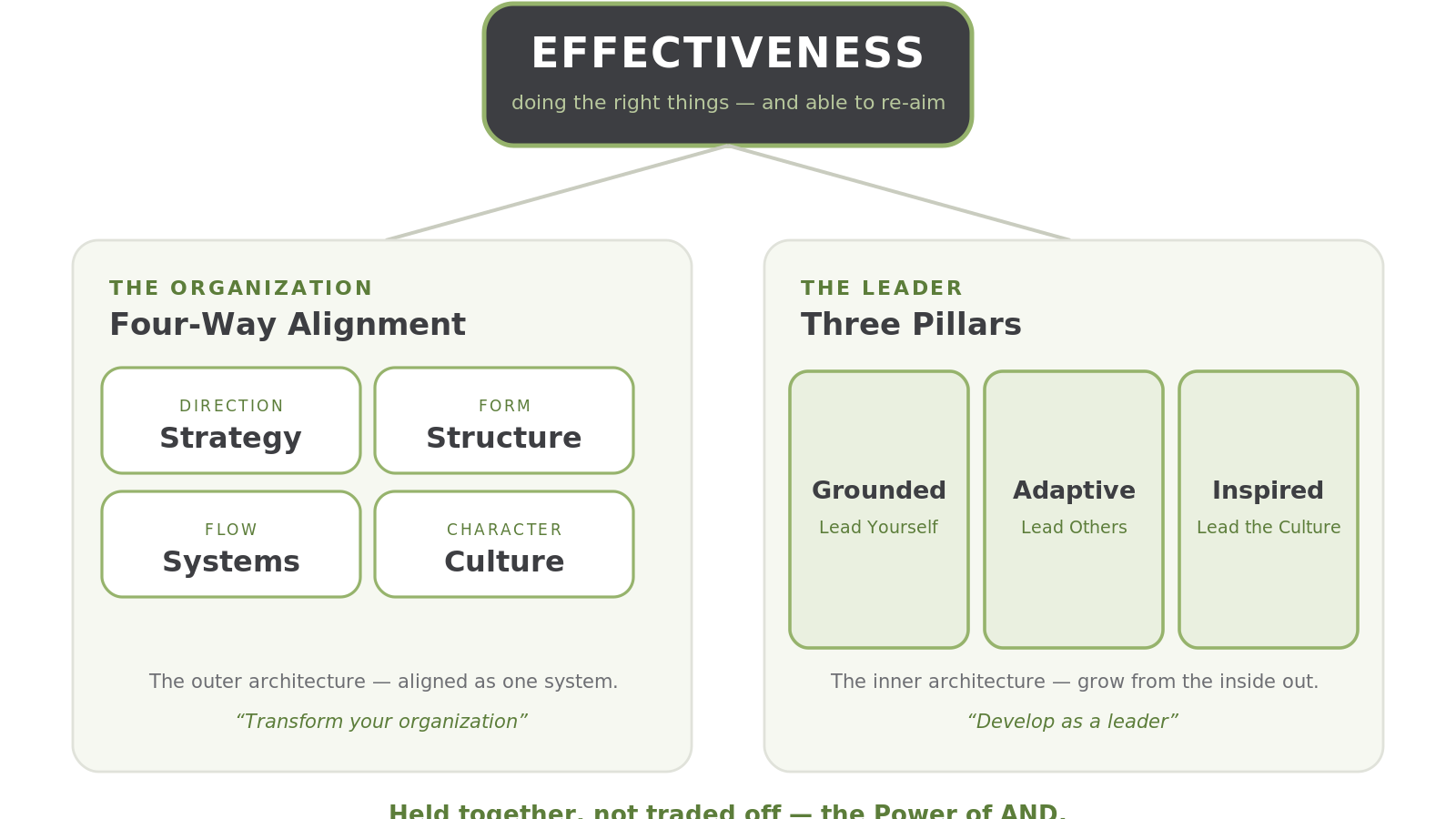
WHERE IS YOUR ORGANIZATION? — OPTIMIZED, OR EFFECTIVE?
The same building blocks — operating-model and RACI design, an evidence-based performance system, and a leadership program to embed it — are available as a structured engagement or as standalone components.
If the pattern above sounds familiar, take the five-minute diagnostic and see which of the dimensions of effectiveness is holding the others back: Optimized, or Effective?
Stay in the Loop!
Subscribe to get notifications of new posts
We hate SPAM. We will never sell your information, for any reason.